3.2.1.1. NXDL Elements and Field Types
The documentation in this section has been obtained directly from the NXDL Schema file: nxdl.xsd. First, the basic elements are defined in alphabetical order. XML attributes of an element are indicated immediately following the element, such as XML attribute name. Then, the common data types used within the NXDL specification are defined. Pay particular attention to the rules for validItemName and validNXClassName.
NXDL Elements
attribute
An NXDL attribute can only be a child of an
NXDL definition, NXDL field, NXDL fieldAttributes or NXDL group.
It is used to define NeXus attributes to be used and their data types
and possibly an enumeration of allowed values.
For more details, see: attributeType
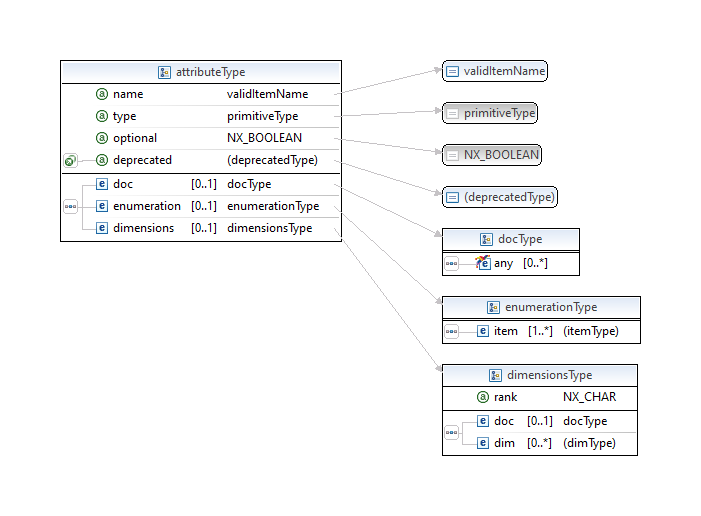
Graphical representation of the NXDL attribute element
choice
An NXDL choice is used when a named NeXus group might take one of several possible NeXus base classes. Logically, it must contain at least two NXDL groups.
For more details, see: choiceType
definition
An NXDL definition can only be used at the root level of an NXDL specification. Note: Due to the large number of XML attributes of the NXDL definition, they have been omitted from the figure below.
For more details, see: definition, definitionType, and definitionTypeAttr
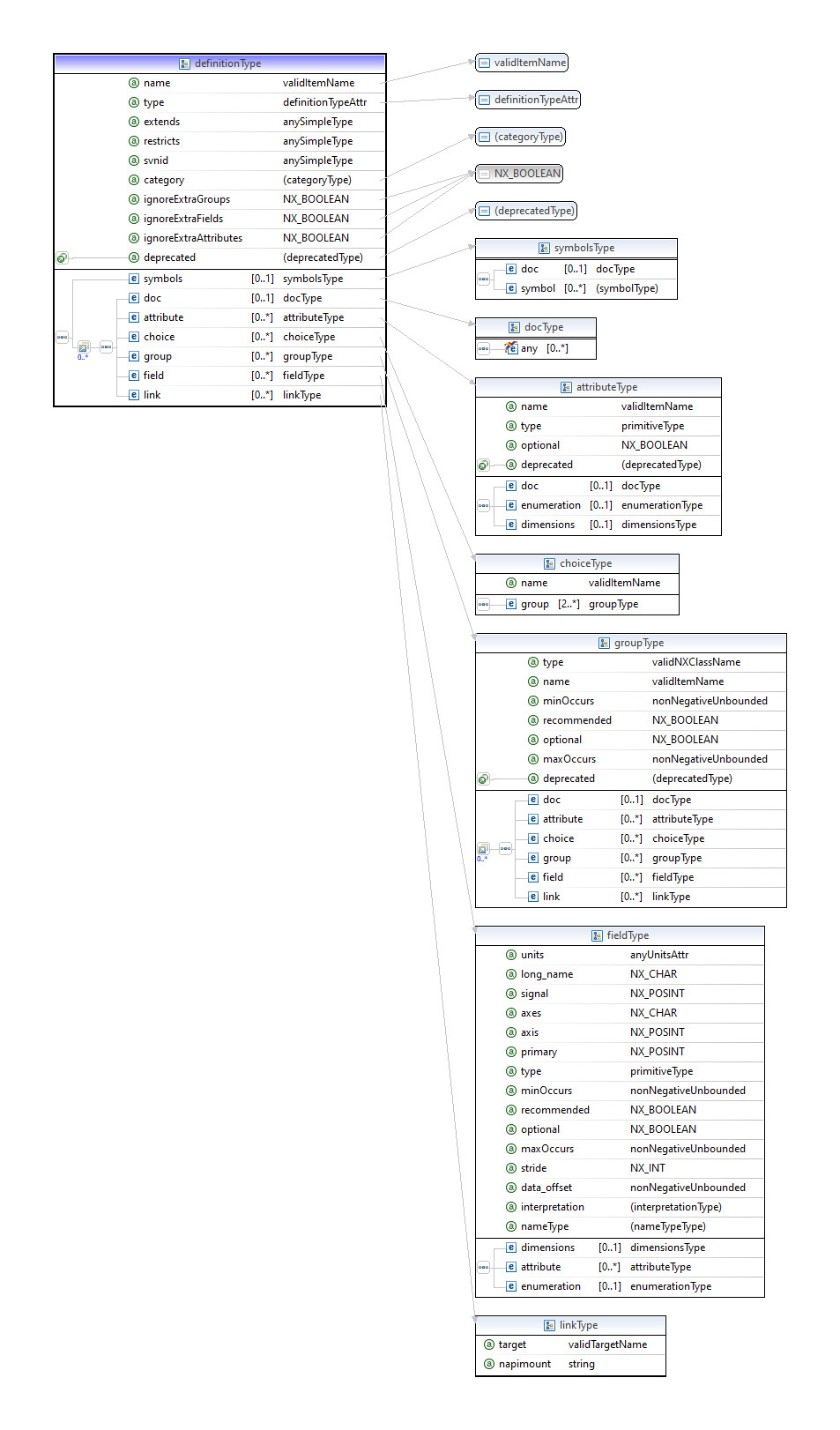
Graphical representation of the NXDL definition element
dimensions
NXDL dimensions describe the shape of an array. It is used only as a child of an NXDL field.
For more details, see: dimensionsType
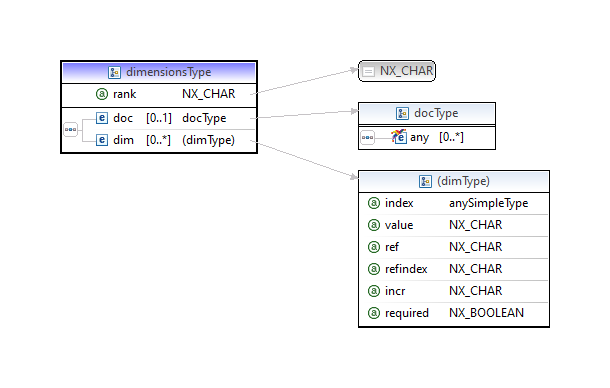
Graphical representation of the NXDL dimensions element
doc
An NXDL doc can be a child of most NXDL elements. In most cases, the text of the NXDL doc will also become part of the NeXus manual.
- element:
{any}:
In documentation, it may be useful to use an element that is not directly specified by the NXDL language. The any element here says that one can use any element at all in an NXDL doc and NXDL will not process it but pass it through.
For more details, see: docType
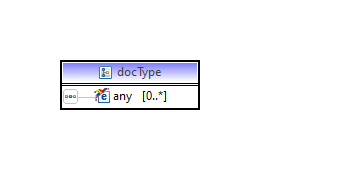
Graphical representation of the NXDL doc element
enumeration
An NXDL enumeration can only be a child of an NXDL field or NXDL attribute. It is used to restrict the available choices to a predefined list, such as to control varieties in spelling of a controversial word (such as metre vs. meter).
For more details, see: enumerationType
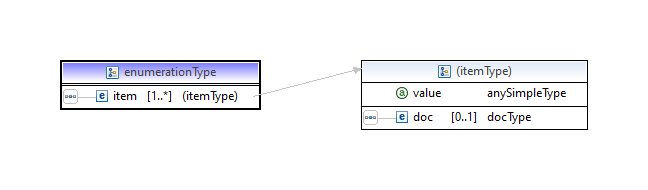
Graphical representation of the NXDL enumeration element
field
The NXDL field defines a NeXus field, which describes content fields. Many
different XML attributes are available to further define the NXDL field.
Some of the XML attributes are not
allowed to be used together (such as axes and axis); see the documentation
of each for details.
It is used only as a child of an NXDL group.
For more details, see: fieldType
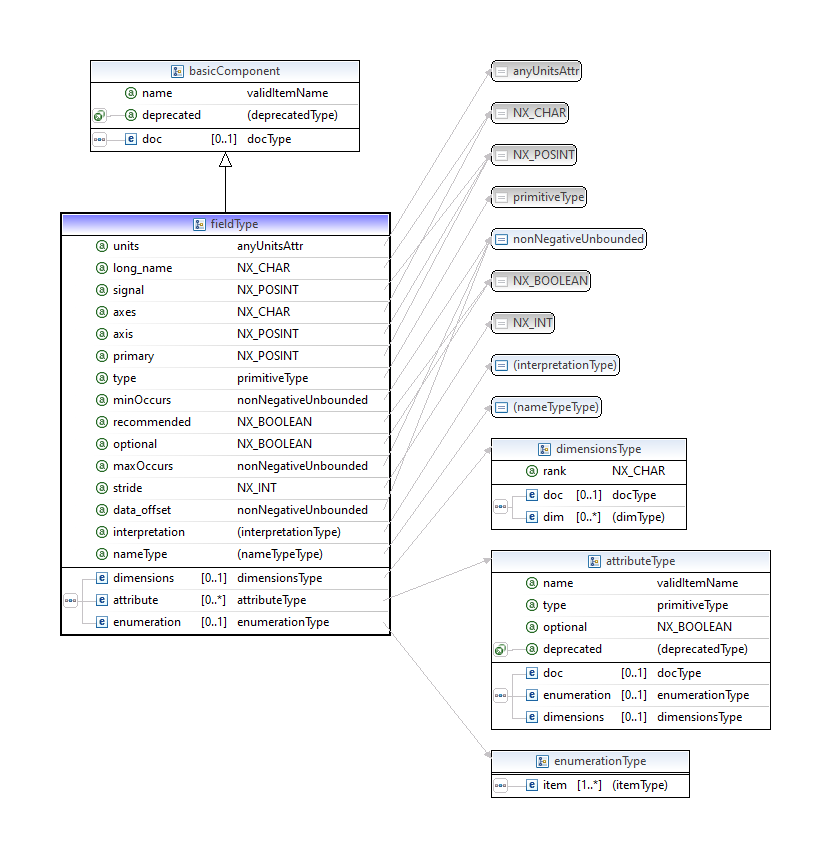
Graphical representation of the NXDL field element
fieldAttributes
An NXDL fieldAttributes can only be a child of an
NXDL definition or NXDL group.
It defines NeXus attributes that any field directly in the class (in an NXDL
definition) or in the NeXus group (in an NXDL group) may have, whether or not
that class or NeXus group defines the field.
For more details, see: fieldAttributesType
group
An NXDL group can only be a child of an NXDL definition or NXDL group. It defines a NeXus group, which describes content groups: levels of organization in a NeXus data file, similar to subdirectories in a file directory tree.
For more details, see: groupType
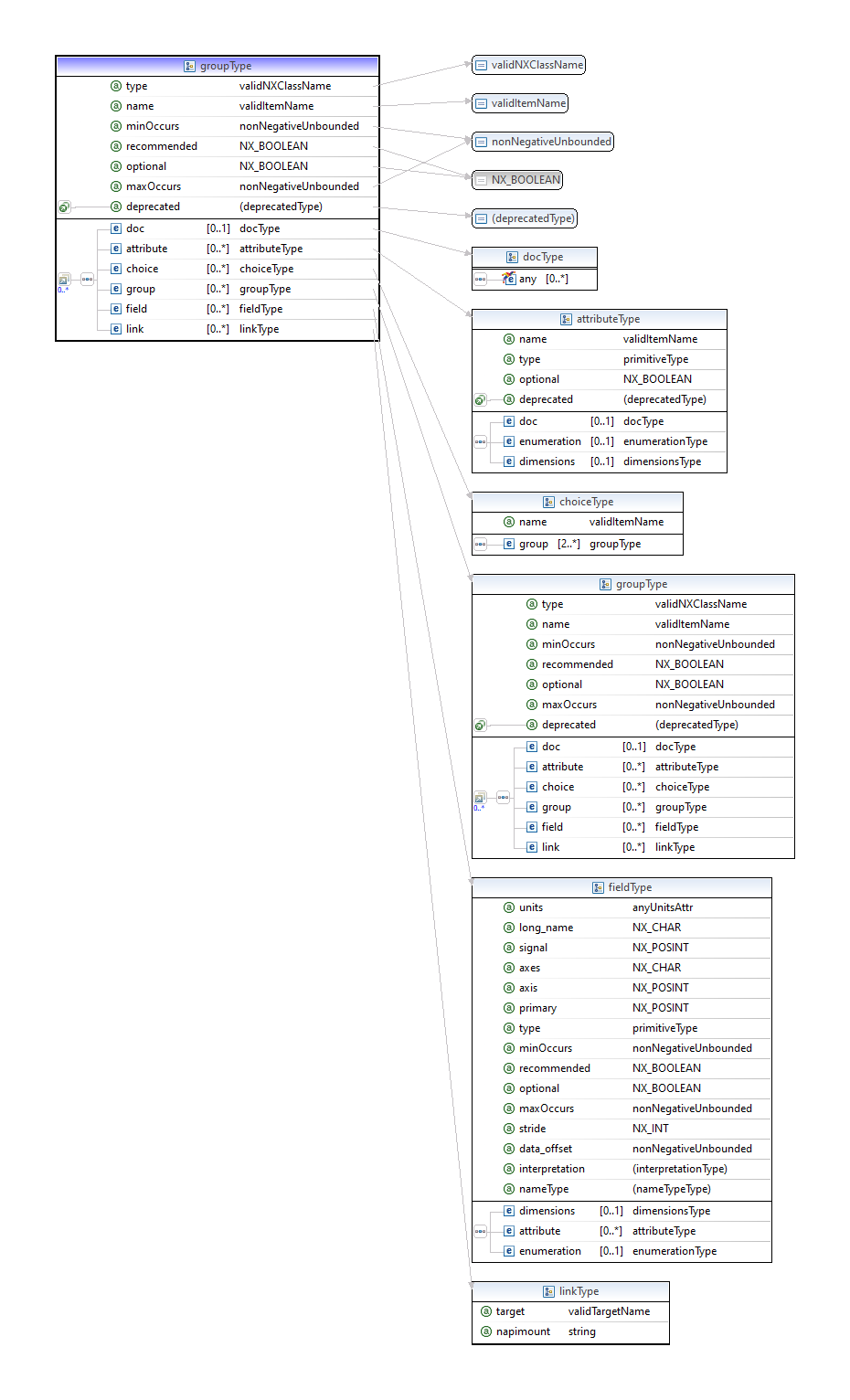
Graphical representation of the NXDL group element
link
An NXDL link can only be a child of an NXDL definition or NXDL group. It defines a NeXus link: a NeXus item that names another NeXus field or group, its target. It describes a content field or group with the same shared content as one that its target describes; one of the two is a content link to the other, or both are content links to the same target.
For more details, see: linkType
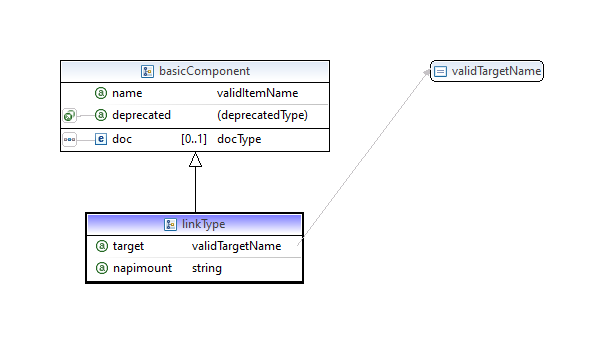
Graphical representation of the NXDL link element
symbols
NXDL symbols can only be a child of an NXDL definition. It defines the array index symbols to be used when defining arrays as NXDL fields with common dimensions and lengths.
For more details, see: symbolsType
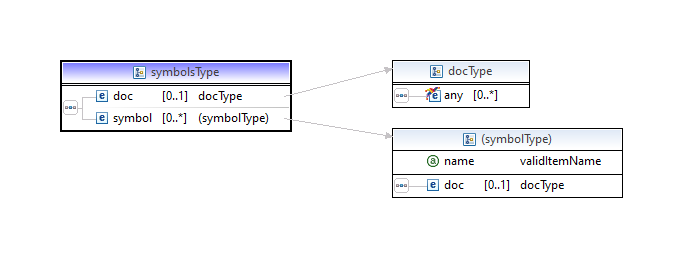
Graphical representation of the NXDL symbols element
NXDL Field Types (internal)
Field types that define the NXDL language are described here.
These data types are defined in the XSD Schema (nxdl.xsd)
and are used in various parts of the Schema to define common structures
or to simplify a complicated entry. While the data types are not intended for
use in NXDL specifications, they define structures that may be used in NXDL specifications.
attributeType
Any new NeXus group or field may expect or require some common NeXus attributes.
(This complex type is used internally in the NXDL schema to declare elements and XML attributes to be used in NXDL files.)
XML attributes of attributeType
XML attribute name
Name of the NeXus attribute (unique among the NeXus attributes of its NeXus group or field).
XML attribute optional
Is this NeXus attribute optional (if true) or required (if false)?
XML attribute recommended
A synonym for optional, but the NeXus attribute that this NXDL attribute defines is recommended.
XML attribute type
Data type of the NeXus attribute, such as
NX_CHAR.
Elements of attributeType
dimensions
dimensions of the NeXus attribute, when its values are arrays
doc
Description of this NXDL attribute. This documentation will go into the manual.
enumeration
An enumeration specifies the values to be used.
groupAttributeType
An NXDL attribute of an NXDL group or NXDL definition: an
attributeType that may also have the XML attribute valueFrom.
(This complex type is used internally in the NXDL schema to declare elements and XML attributes to be used in NXDL files.)
XML attribute valueFrom
The value of this NeXus attribute is not fixed but comes from the NeXus group it belongs to (see valueFromType). Cannot be combined with an NXDL enumeration.
definition
An NXDL definition is the element at the root of every NXDL specification; it defines a NeXus class. It may only appear at the root of an NXDL file and must only appear once for the NXDL to be well-formed.
definitionType
A definition is the root element of every NXDL definition.
It may only appear at the root of an NXDL file and must only
appear once for the NXDL to be well-formed.
The definitionType declares the XML attributes of the NXDL definition
and the NXDL docs, attributes, fields and groups
that will be used as its children.
Could contain these elements:
attributedocfieldfieldAttributesgrouplink
Unlike fieldType and linkType, definitionType does not extend the
basicComponent complex type.
(The definitionType complex type is used internally in the NXDL schema
to declare elements and XML attributes to be used in NXDL files.)
Note that the first line of text in an NXDL doc in an NXDL definition is used as a summary in the manual. Follow the pattern as shown in the base class NXDL files.
XML attributes of definitionType
XML attribute category
NXDL
basedefinitions define the NeXus items to use for these components. All NeXus items of a base class are optional, except the NeXus attribute@NX_classof a NeXus group (see NXobject). NXDLapplicationdefinitions define what is required for a scientific interest. All NeXus items of an application definition are required, unless their XML attributes say otherwise. NXDLcontributeddefinitions may be considered either base or applications. Contributed definitions must indicate their intended use, either as a base class or as an application definition.
XML attribute extends
The XML attribute
extendsallows this definition to subclass from another NeXus class, otherwiseextends="NXobject"should be used.
XML attribute ignoreExtraAttributes
Only validate known content attributes; do not warn about unknowns. The XML attribute
ignoreExtraAttributesis a flag to the process of validating NeXus data files. By settingignoreExtraAttributes="true", presence of any content attributes that no NeXus attribute describes, in a content group of this class, will not generate warnings during validation. Normally, validation will check all the content attributes against the NeXus items of the base classes and application definitions that describe them. Any content that no NeXus item describes will generate a warning message.The XML attribute
ignoreExtraAttributesshould be used sparingly!
XML attribute ignoreExtraFields
Only validate known content fields; do not warn about unknowns. The XML attribute
ignoreExtraFieldsis a flag to the process of validating NeXus data files. By settingignoreExtraFields="true", presence of any content fields that no NeXus field describes, in a content group of this class, will not generate warnings during validation. Normally, validation will check all the content fields against the NeXus items of the base classes and application definitions that describe them. Any content that no NeXus item describes will generate a warning message.The XML attribute
ignoreExtraFieldsshould be used sparingly!
XML attribute ignoreExtraGroups
Only validate known content groups; do not warn about unknowns. The XML attribute
ignoreExtraGroupsis a flag to the process of validating NeXus data files. By settingignoreExtraGroups="true", presence of any content groups that no NeXus group describes, in a content group of this class, will not generate warnings during validation. Normally, validation will check all the content groups against the NeXus items of the base classes and application definitions that describe them. Any content that no NeXus item describes will generate a warning message.The XML attribute
ignoreExtraGroupsshould be used sparingly!
XML attribute name
The name of the NeXus class that this NXDL definition defines; also the NXDL file name without the file extension (case sensitive). The name must be unique amongst all the NeXus base class, application, and contributed definitions. For the class to be adopted by the NIAC, the first two letters must be “
NX” (in uppercase). Any other use must not begin with “NX” in any combination of upper or lower case.
XML attribute restricts
The XML attribute
restrictsis a flag to the data validation. Whenrestricts="1", any non-standard component found (and checked for validity against this NXDL specification) in a NeXus data file will be flagged as an error. If the XML attributerestrictsis not present, any such situations will produce a warning.
XML attribute svnid
(2014-08-19: deprecated since switch to GitHub version control) The identifier string from the subversion revision control system. This reports the time stamp and the revision number of this file.
XML attribute type
Must be
type="group"
Elements of definitionType
fieldAttributes
Defines NeXus attributes that any field directly in this class may have, whether or not the class defines that field. Like the other NeXus items of a class, they are inherited by the classes that extend it.
symbols
Use a
symbolslist to define each of the mnemonics that represent the length of each dimension in a vector or array.
Model groups of definitionType
In addition to an optional
symbolslist, an NXDL definition may contain any of the elements allowed in an NXDL group.
definitionTypeAttr
Prescribes the allowed values for the XML attribute type of the NXDL definition.
(This data type is used internally in the NXDL schema
to define a data type.)
The value may be any one from this list only:
groupdefinition
dimensionsType
dimensions of a NeXus field or attribute (This complex type is used internally in the NXDL schema to declare elements and XML attributes to be used in NXDL files.)
XML attributes of dimensionsType
XML attribute rank
Rank (number of dimensions) of the data structure.
Value could be either an unsigned integer or a symbol as defined in the symbol table of the NXDL file.
For example:
a[5]hasrank="1"whileb[8,5,6,4]hasrank="4". See https://en.wikipedia.org/wiki/Rank_%28computer_programming%29 for more details.
Elements of dimensionsType
dim
Specify the parameters for each index of the NXDL dimensions with a
dimelement. The number ofdimentries should be equal to therankof the array. For example, these terms describe a 2-D array with lengths (nsurf,nwl):1The XML attribute
valueis used by NXDL and also by the NeXus data file validation tools to associate and coordinate the same array length across multiple NeXus fields in a group.
XML attribute incr
Deprecated: 2016-11-23 telco (https://github.com/nexusformat/definitions/issues/330)
The dimension specification is related to the
refindexaxis within the NeXus fieldrefby an offset ofincr. Requires the XML attributesrefandrefindexto be present.
XML attribute index
Number or symbol indicating which axis (subscript) is being described, ranging from 1 up to
rank(rank of the data structure). For example, given an arrayA[i,j,k],index="1"would refer to theiaxis (subscript).
XML attribute ref
Deprecated: 2016-11-23 telco (https://github.com/nexusformat/definitions/issues/330)
The dimension specification is the same as that of the NeXus field the XML attribute
refnames, specified either by a relative path, such aspolar_angleor../Qvecor absolute class path, such as/NXentry/NXinstrument/NXdetector/polar_angle.
XML attribute refindex
Deprecated: 2016-11-23 telco (https://github.com/nexusformat/definitions/issues/330)
The dimension specification is the same as the
refindexaxis within the NeXus fieldref. Requires the XML attributerefto be present.
XML attribute required
This dimension is required (true: default) or not required (false).
The default value is
true.When
required="false"is specified, all subsequent<dimnodes (with higherindexvalue) must also haverequired="false".
XML attribute value
Integer length (number of values), or mnemonic symbol representing the length of this axis.
doc
Documentation might be necessary to describe how the parts of the NXDL dimensions are to be used.
docType
NXDL allows for documentation on most elements using an NXDL doc. The documentation is useful in several contexts. The documentation will be rendered in the manual. Documentation, is provided as tooltips by some XML editors when editing NXDL files. Simple documentation can be typed directly in the NXDL:
Descriptive name of sample
This is suitable for basic descriptions that do not need extra formatting such as a bullet-list or a table. For more advanced control, use the rules of restructured text, such as in the NXdetector specification. Refer to examples in the NeXus base class NXDL files such as NXdata.
Could contain these elements:
any
(This complex type is used internally in the NXDL schema to declare elements and XML attributes to be used in NXDL files.)
Note:
For documentation of NXDL definitions,
the first line of text in a doc
is used as a summary in the manual.
Follow the pattern as shown
in the base class NXDL files.
enumerationType
An NXDL enumeration restricts the values allowed for a NeXus field or attribute.
Each value is specified using an item element, such as:
<item value="Synchrotron X-ray Source" />.
Could contain these elements:
docitem
(This complex type is used internally in the NXDL schema to declare elements and XML attributes to be used in NXDL files.)
source operating mode

        for storage rings
        for storage rings
Enumerations can be closed or open. A closed enumeration is one where the list of values are the only ones allowed for a specification. An open enumeration is one where the list of values is incomplete and additional values other than those listed are allowed. Open enumerations should be used sparingly as the designer of the enumeration should try to find all possible values for a given NeXus field or attribute.
In case an open enumeration is used and the data provider wants to declare that the provided value deliberately not from the given list of values, the data provider should,
for content fields, set the content attribute
@custom=True.for content attributes, set an additional content attribute
@my_attribute_custom=True, wheremy_attributeis the name of the content attribute with the open enumeration.
Such content attributes can be used deliberately to suppress warnings in NeXus validators.
XML attributes of enumerationType
XML attribute open
Is this an open enumeration? An open enumeration allows additional values not listed.
Elements of enumerationType
item
One of the prescribed values. Use the XML attribute
value.Defines the value of one selection for an
enumerationlist. Each enumerated item must have a value (it cannot have an empty text node).
XML attribute value
The value of
valueof anenumItemis defined as an XML attribute rather than a name.
doc
Individual items can be documented but this documentation might not be printed in the NeXus Reference Guide.
fieldType
An NXDL field defines a NeXus field of the class or NeXus group being defined. That NeXus field describes content fields, which are stored as an HDF4 SDS (Scientific Data Set) or an HDF5 dataset. Could contain these elements:
attributedimensionsdocenumeration
The XML attributes long_name, signal, axes, axis,
primary, interpretation, stride and data_offset
of an NXDL field give the value of the NeXus attribute with that name of
the NeXus field, for example signal="1"; their declarations below constrain only the NXDL file.
The XML attribute units gives the units
category or an example of the units, not the value of @units.
Other NeXus attributes of the NeXus field are defined with
NXDL attributes.
Note that an NXDL field also includes the declarations of the
basicComponent complex type.
(The fieldType complex type is used internally in the NXDL schema
to declare elements and XML attributes to be used in NXDL files.)
XML attribute axes
NOTE: Use of the XML attribute
axesfor an NXDL field is discouraged. It is for legacy support. You should use the NeXus attribute@axesof the NeXus group (such as in NXdata) instead.This XML attribute contains a string array that defines the independent NeXus fields used in the default plot for all of the dimensions of the signal field (the signal field is the NeXus field in this NeXus group that is named by the NeXus attribute
@signalof this NeXus group).When there is only one item in the string array, it is acceptable to set the value to the one string. In such case, it is not necessary to make it an array of one string.
Presence of the XML attribute
axesmeans this NeXus field is an ordinate.
XML attribute axis
NOTE: Use of this XML attribute is discouraged. It is for legacy support. You should use the NeXus attribute
@axesof the NeXus group (such as in NXdata) instead.Presence of the XML attribute
axismeans this NeXus field is an abscissa.The XML attribute value is an integer indicating this NeXus field as an axis that is part of the data set. The data set is the NeXus field in the same NeXus group whose NeXus attribute
@signalis 1. The value can range from 1 up to the number of independent axes (abscissae) in the data set.A value of
axis="1"indicates that this NeXus field contains the data for the first independent axis. For example, the X axis in an XY data set.A value of
axis=2indicates that this NeXus field contains the data for the second independent axis. For example, the Y axis in a 2-D data set.A value of
axis=3indicates that this NeXus field contains the data for the third independent axis. For example, the Z axis in a 3-D data set.An NXDL field with an XML attribute
axisshould not have an XML attributesignal.
XML attribute data_offset
Deprecated: not used by any NeXus definition; NXobject defines the NeXus attribute
@data_offsetof every field. The declaration of this XML attribute constrains only the NXDL file: its type and default never applied to that NeXus attribute.The XML attributes
strideanddata_offsetare used together to index the array of data items in a multi-dimensional array. They may be used as an alternative method to address a data array that is not stored in the standard NeXus method of “C” order.The XML attribute
data_offsetdetermines the starting coordinates of the data array for each dimension.See https://support.hdfgroup.org/HDF5/Tutor/phypereg.html or 4. Dataspace Selection Operations in https://portal.hdfgroup.org/display/HDF5/Dataspaces
The XML attribute
data_offsetcontains a comma-separated list of integers. (In addition to the required comma delimiter, whitespace is also allowed to improve readability.) The number of items in the list is equal to the rank of the data being stored. The value of each item is the offset in the array of the first data item of that subscript of the array.
XML attribute interpretation
Deprecated: not used by any NeXus definition; NXobject defines the NeXus attribute
@interpretationof every field. The declaration of this XML attribute constrains only the NXDL file: its type and default never applied to that NeXus attribute.This instructs the consumer of the data what the last dimensions of the data are. It allows plotting software to work out the natural way of displaying the data.
For example a single-element, energy-resolving, fluorescence detector with 512 bins should have
interpretation="spectrum". If the detector is scanned over a 512 x 512 spatial grid, the data reported will be of dimensions: 512 x 512 x 512. In this example, the initial plotting representation should default to data of the same dimensions of a 512 x 512 pixelimagedetector where the images where taken at 512 different pressure values.In simple terms, the allowed values mean:
scalar= 0-D data to be plotted
scaler= DEPRECATED, usescalar
spectrum= 1-D data to be plotted
image= 2-D data to be plotted
rgb-image= 3-D data to be plotted
rgba-image= 3-D data to be plotted
hsl-image= 3-D data to be plotted
hsla-image= 3-D data to be plotted
cmyk-image= 3-D data to be plotted
vertex= 3-D data to be plotted
XML attribute long_name
Deprecated: not used by any NeXus definition; NXobject defines the NeXus attribute
@long_nameof every field. The declaration of this XML attribute constrains only the NXDL file: its type and default never applied to that NeXus attribute.Descriptive name for this NeXus field (may include whitespace and engineering units). Often, the long_name (when defined) will be used as the axis label on a plot.
XML attribute maxOccurs
Maximum occurrence of the NeXus field that this NXDL field defines. Its value is confined to zero or greater. Must be greater than or equal to the value for the XML attribute
minOccurs. A value of “unbounded” is allowed.
XML attribute minOccurs
Minimum occurrence of the NeXus field that this NXDL field defines. Its value is confined to zero or greater. Must be less than or equal to the value for the XML attribute
maxOccurs.
XML attribute optional
A value of “true” is equivalent to minOccurs=0 while a value of “false” is equivalent to minOccurs>0.
XML attribute primary
Integer indicating the priority of selection of this NeXus field for plotting (or visualization) as an axis.
Presence of the XML attribute
primarymeans this NeXus field is an abscissa.
XML attribute recommended
A synonym for optional, but the NeXus field that this NXDL field defines is recommended.
XML attribute signal
Presence of the XML attribute
signalmeans this NeXus field is an ordinate.Integer marking this NeXus field as plottable data (ordinates). The value indicates the priority of selection or interest. Some facilities only use
signal=1while others usesignal=2to indicate plottable data of secondary interest. Higher numbers are possible but not common and interpretation is not standard.An NXDL field with an XML attribute
signalshould not have an XML attributeaxis.
XML attribute stride
Deprecated: not used by any NeXus definition; NXobject defines the NeXus attribute
@strideof every field. The declaration of this XML attribute constrains only the NXDL file: its type and default never applied to that NeXus attribute.The XML attributes
strideanddata_offsetare used together to index the array of data items in a multi-dimensional array. They may be used as an alternative method to address a data array that is not stored in the standard NeXus method of “C” order.The
stridelist chooses array locations from the data array with each value in thestridelist determining how many elements to move in each dimension. Setting a value in thestridearray to 1 moves to each element in that dimension of the data array, while setting a value of 2 in a location in thestridearray moves to every other element in that dimension of the data array. A value in thestridelist may be positive to move forward or negative to step backward. A value of zero will not step (and is of no particular use).See https://support.hdfgroup.org/HDF5/Tutor/phypereg.html or 4. Dataspace Selection Operations in https://portal.hdfgroup.org/display/HDF5/Dataspaces
The XML attribute
stridecontains a comma-separated list of integers. (In addition to the required comma delimiter, whitespace is also allowed to improve readability.) The number of items in the list is equal to the rank of the data being stored. The value of each item is the spacing of the data items in that subscript of the array.
XML attribute type
XML attribute units
String describing the engineering units. The string should be appropriate for the value.
If a unit is not provided by the list of NeXus unit categories, instead of providing a category, an NXDL field can include an example of the units directly.
The example does not constrain the scale of the units. For example, if the unit is
eV/mm, the user could specify in a data fileeV/cm, or any other unit that is convertible to the example given.It is recommended that users and application developers check if their units and their unit examples adhere to the UDUNITS standard. [1]
Conformance is not validated at this time.
attribute
NeXus attributes to be used with this NeXus field
dimensions
dimensions of the NeXus field
enumeration
An NXDL field can specify which values are to be used
fieldAttributesType
An NXDL fieldAttributes defines NeXus attributes that any field directly in
a class or NeXus group may have, whether or not that class or NeXus group
defines the field. Fields in nested NeXus groups are not affected.
As a child of the NXDL definition of a base class, it applies to every field directly in that class, and is inherited by the classes that extend it (see NXobject). No NeXus group has an application definition as its type, so an application definition may not have
fieldAttributesas a direct child (checked by the repository’s Python syntax check, not bynxdl.xsd).As a child of an NXDL group, it applies to every field directly in the NeXus group that this NXDL group defines, in addition to the
fieldAttributesof the type of that NeXus group.
An NXDL attribute of an NXDL field always takes
precedence over one with the same name in fieldAttributes.
When several fieldAttributes contain an NXDL attribute with the
same name, the one closest to the field takes precedence: the
enclosing NXDL group, then the same NXDL group in the application
definitions that its NXDL definition extends (closest first), then the
NXDL definition of the type of its NeXus group, then the classes that
class extends.
The NXDL attribute that takes precedence replaces the others, as a
subclass overrides an inherited NeXus item (see Inheritance in NeXus).
Could contain these elements:
attributedoc
(This complex type is used internally in the NXDL schema to declare elements and XML attributes to be used in NXDL files.)
Elements of fieldAttributesType
attribute
An NXDL attribute that defines a NeXus attribute that any field directly in the class or NeXus group that
fieldAttributesapplies to may have.
doc
Describe these NeXus attributes. This documentation will go into the manual.
choiceType
An NXDL choice is used when a named NeXus group might be of one of several possible NeXus base classes. Logically, it must contain at least two NXDL groups.
XML attributes of choiceType
XML attribute name
The name of the NeXus group that the selected child NXDL group defines. None of the child NXDL groups should have an XML attribute
name.
Elements of choiceType
group
An NXDL group whose type is a base class that could be used here. The NXDL group will take the XML attribute
nameof the parent NXDL choice so do not specify the XML attributenameof the NXDL group here.
groupType
An NXDL group defines a NeXus group of the class or NeXus group being defined; its type is an existing class. Could contain these elements:
attributedocfieldfieldAttributesgrouplink
Unlike fieldType and linkType, groupType does not extend the
basicComponent complex type: its XML attribute name is optional.
(The groupType complex type is used internally in the NXDL schema
to declare elements and XML attributes to be used in NXDL files.)
XML attributes of groupType
XML attribute maxOccurs
Maximum occurrence of the NeXus group that this NXDL group defines. Note each NXDL group must have an XML attribute
namethat is unique among all NXDL groups and NXDL fields within a common parent element.
XML attribute minOccurs
Minimum occurrence of the NeXus group that this NXDL group defines. Note each NXDL group must have an XML attribute
namethat is unique among all NXDL groups and NXDL fields within a common parent element.
XML attribute name
A particular scientific application may expect a name of a NeXus group. It is helpful but not required to specify the XML attribute
namein the NXDL file. It is suggested to always specify anameto avoid ambiguity. It is also suggested to derive thenamefrom the type, using an additional number suffix as necessary. For example, consider a data file with only oneNXentry. The suggested defaultnamewould beentry. For a data file with two or moreNXentrygroups, the suggested names would beentry1,entry2, … Alternatively, a scientific application such as small-angle scattering might require a different naming procedure; two differentNXaperturegroups might be given the namesbeam_defining_slitandscatter_slit.
XML attribute optional
A value of “true” is equivalent to minOccurs=0 while a value of “false” is equivalent to minOccurs>0.
XML attribute recommended
A synonym for optional, but the NeXus group that this NXDL group defines is recommended.
XML attribute type
The XML attribute
typemust contain the name of a NeXus base class (including contributed base classes): the type of the NeXus group that this NXDL group defines. It may not be an application definition (checked by the repository’s Python syntax check, not bynxdl.xsd).
Elements of groupType
fieldAttributes
Defines NeXus attributes that any field directly in the NeXus group this NXDL group defines may have, whether or not that NeXus group defines the field.
Model groups of groupType
An NXDL group may be contained within another NXDL group.
linkType
An NXDL link defines a NeXus link: a NeXus item that names another NeXus field or group, its target. It describes a content field or group with the same shared content as one that its target describes; one of the two is a content link to the other, or both are content links to the same target. Use it to avoid needless repetition of information.
In a data file this requires that
the content group described by the enclosing NeXus group contains a content field or group whose name is the value of the XML attribute
name;it and a content field or group that the target describes have the same shared content;
one of the two is a content link to the other, or both are content links to the same target: the content attribute
@target(see NXobject) of one is the path of the other, or both have the same@target.
Either of the two may be the content link.
An NXDL link defines no type, units, dimensions or NeXus attributes of its own: those of its target apply. An NXDL link has no occurrence XML attributes, so the NeXus link it defines is required in an application definition.
A content field or group may be a content link in a data file without a NeXus link describing it. (This complex type is used internally in the NXDL schema to declare elements and XML attributes to be used in NXDL files.)
XML attribute napimount
Deprecated: not used by any NeXus definition. URL of an HDF5 group in another file (see HDF5 external links). NXDL enforces nothing about it.
XML attribute target
Class path of the target: the NeXus field or group whose content fields or groups must have the same shared content (see validTargetName). It is written with class names, so it names a NeXus item, not a path in a data file.
NXDL does not require that the value of the content attribute
@targetmatches this path.This XML attribute is not the content attribute
@targetof a content field or group in a data file (see NXobject).For example, an NXDL group of type
NXdatathat contains:<link name="polar_angle" target="/NXentry/NXinstrument/NXdetector/polar_angle"/>is satisfied by this data, where both content fields have the same shared content:
entry:NXentry
        data:NXdata
                polar_angle:NX_NUMBER
                        @target="/entry/instrument/detector/polar_angle"
        instrument:NXinstrument
                detector:NXdetector
                        polar_angle:NX_NUMBER
                                @target="/entry/instrument/detector/polar_angle"
symbolsType
Each symbol element has an XML attribute name and optional documentation.
Please provide documentation that indicates what each symbol represents.
For example:
number of reflecting surfaces
number of wavelengths
Elements of symbolsType
doc
Describe the purpose of this list of
symbols. This documentation will go into the manual.
symbol
When multiple NeXus fields share the same dimensions, such as the dimension scales associated with plottable data in an
NXdatagroup, the length of each dimension written in a NeXus data file should be something that can be tested by the data file validation process.
XML attribute name
Mnemonic variable name for this array index symbol.
doc
Describe the purpose of the parent
symbolelement. This documentation will go into the manual.
basicComponent
A basicComponent declares the allowed name
format and XML attributes common to all NXDL fields
and NXDL groups.
(This complex type is used internally in the NXDL schema
to declare elements and XML attributes to be used in NXDL files.)
XML attributes of basicComponent
XML attribute name
The XML attribute
nameis the identifier string for this entity. It is required thatnamemust be unique within the enclosing NXDL group. The name must match the regular expression defined byvalidItemName. (Historical note: Originally, the rule (validItemName) was defined to allow only names that can be represented as valid variable names in most computer languages. )
Elements of basicComponent
doc
Describe this
basicComponentand its use. This documentation will go into the manual.
validItemName
Used for allowed values of the XML attribute name of elements:
the names of NeXus groups, fields and attributes.
Note: No - characters (among others) are allowed
and you cannot start or end with a period (.).
HDF4 had a 64 character limit on names
(possibly including NULL) and the NAPI enforces this
via the NX_MAXNAMELEN variable with
a 64 character limit (which
may be 63 on a practical basis if one considers a NULL
terminating byte).
(This data type is used internally in the NXDL schema
to define a data type.)
NOTE: In some languages, it may be necessary to add a
^ at the start and a $ at the end of the regular
expression to constrain the match to an entire line.
The value may be any
xs:token that also matches the regular expression:
[a-zA-Z0-9_]([a-zA-Z0-9_.]*[a-zA-Z0-9_])?
validNXClassName
Used for allowed names of NX class types (e.g. NXdetector).
Note this is not the name of a NeXus group (e.g. bank1), which is covered
by validItemName.
(This data type is used internally in the NXDL schema
to define a data type.)
The value may be any
nx:validItemName that also matches the regular expression:
NX.+
validTargetName
An absolute class path naming a
NeXus field or group, used as the XML attribute target of an NXDL link.
Each /-separated segment is the class of a NeXus group (NXcrystal),
the name and class of a NeXus group (analyzer:NXcrystal), or the name of
a NeXus field (ef):
/NXentry/NXinstrument/analyzer:NXcrystal/ef
/NXentry/NXinstrument/monochromator:NXcrystal/ei
/NX_other
Because it is written with class names, it names a NeXus item,
not a path in a data file.
Currently it must be an absolute path; we may want to consider
allowing “..” (parent of directory) at some point.
Must also consider use of the XML attribute name in resolving the targets of NeXus links.
(This data type is used internally in the NXDL schema
to define a data type.)
From the HDF5 documentation:
Note that relative path names in HDF5 do not employ the ``../`` notation, the UNIX notation indicating a parent directory, to indicate a parent group.
Thus, if we only consider the case of
[name:]type, the matching regular expression syntax
is written: /[a-zA-Z_][\w_]*(:[a-zA-Z_][\w_]*)?)+.
Note that HDF5 also permits relative path names, such as:
GroupA/GroupB/Dataset1
but this is not permitted in the matching regular expression.
The value may be any
xs:token that also matches the regular expression:
(/[a-zA-Z_][\w_]*(:[a-zA-Z_][\w_]*)?)+
nonNegativeUnbounded
A nonNegativeUnbounded allows values including
all positive integers, zero, and the string unbounded.
(This data type is used internally in the NXDL schema
to define a data type.)
valueFromType
Where the value of a NeXus attribute of a NeXus group comes from, as given by
the XML attribute valueFrom of the NXDL attribute that defines it.
(This simple type is used internally in the NXDL schema.)
The value may be any one from this list only:
classThe type of the NeXus group that the NeXus attribute belongs to, the name of a class: the XML attribute
typeof the NXDL group that defines that NeXus group, or the XML attributenameof the NXDL definition, for a NeXus attribute that the class itself has. For a NeXus attribute inherited from another class, such as NXobject, it is the type of that NeXus group, not the class that defines the NeXus attribute.
- The
xs:stringdata type The
xs:stringdata type can contain characters, line feeds, carriage returns, and tab characters. See https://www.w3schools.com/xml/schema_dtypes_string.asp for more details.- The
xs:tokendata type The
xs:stringdata type is derived from thexs:stringdata type.The
xs:tokendata type also contains characters, but the XML processor will remove line feeds, carriage returns, tabs, leading and trailing spaces, and multiple spaces. See https://www.w3schools.com/xml/schema_dtypes_string.asp for more details.